Showing posts with label wildflowers. Show all posts

Saturday, June 02, 2018

Peace in the Woods

I love the woods in spring time.  It's so peaceful and inspirational to see the light green buds open on branches that, for 6 months,  had looked as if they were not even alive.  I found the little woodlot in front of our main mall covered in white blossoms.  Beautiful!  Trilliums!  I hope they never build on this lovely spot.


Saturday, May 24, 2014

Switching my Quilt Addiction for a Plant Addiction

It's finally planting season.  I have been busy - digging, pulling weeds, moving things around and buying plants from the nursery.  I managed to get a couple of quilt blocks done, but not much else as far as sewing goes.

Last weekend my DH and I went for a walk in the woods.  I used some walking sticks - you know the kind that have spikes on the ends, much like ski poles - and I was able to get around without any problems. There were a few trilliums in the woods.  They were just beautiful.  I love seeing the trilliums,  When they are in bloom I know it's spring!


I also spotted a plant that I don't think I have ever seen before.  I think it is a Toothwort.  If you know this plant or know what it really is, please leave me a comment.  Thanks.


To all my friends south of the border, have a fantastic long weekend!  We had ours last weekend.  Drive carefully and stay safe.  The weather is just perfect here at the moment.  I am going back outside to plant a few more things.  Hopefully I will have time to do a bit of quilting next week.


Thursday, October 10, 2013

Thursday's Weed

The charger for my scooter has been replaced and I can now charge up the batteries and get out of the house.  You have no idea how liberating that is!  I have felt like a prisoner for about 3 weeks and I had no way of taking more photos of wildflowers to post on Wednesdays.

But yesterday my batteries were fully charged and I went to the library.  As I drove around my neighbourhood I noticed the growth of a weed that everybody hates.  It's called Ragweed.


This is not a wildflower.  It's a full-out noxious weed!  But it does have flowers and that's where the problem starts.  This plant is the bane of allergy sufferers everywhere.

Although it is a plant that originally grew in rural areas, it has adapted itself and now grows just about everywhere.  Here is some that is growing in a crack along the side of the road, between the pavement and the curb.


The problem with Ragweed is the pollen.  Ragweed plants can produce up to a billion pollen grains per plant. This pollen is very small and light-weight and can travel for up to 400 km, carried by the wind.  It causes runny noses and watery eyes for many sufferers. Male and female flowers are borne on each plant, but it is the male flowers that produce the pollen.

It always irritates me when pictures of other wildflowers, such as Goldenrod or Dandelions, accompany articles relating to hay fever.  Those plants don't cause hay fever.  You, see, it is the colour of the flowers that gives them away.  Ragweed has green flowers and the others have coloured flowers.  It is only the green flowering plants that produce pollen light enough to float through the air.  The pollen grains of Goldenrod and Dandelions are large and heavy and depend on bees and other insects to pollinate them.  Ragweed relies only on the wind to blow its pollen around to other plants.  So when you see a wonderful field of yellow Goldenrod or the first golden globes of Dandelion-colour in spring, don't stay away from them.  They cannot hurt you.  They are the 'good' plants.


Here is some Ragweed growing beside the bus stop on Lawrence Ave. E.

Ragweed belongs to the Asteraceae family, like Sunflowers and Asters.  The thing that makes me cringe is that they are in the Genus, Ambrosia.  That makes me think of wonderful foods from the gods.  But I think it only refers to this plant's tenacity to thrive just about everywhere. This definitely is a noxious weed!  If you have it in your garden or see it growing along the side of the road beside your boulevard, pull it out!  Other than providing food for a few caterpillars, this plant does nothing for the beauty of our planet.  At least not by my standards.  I don't suffer from allergies, but maybe I am just a little bit biased.


Wednesday, October 02, 2013

This Should be Wildflower Wednesday, but I have More Exciting News!

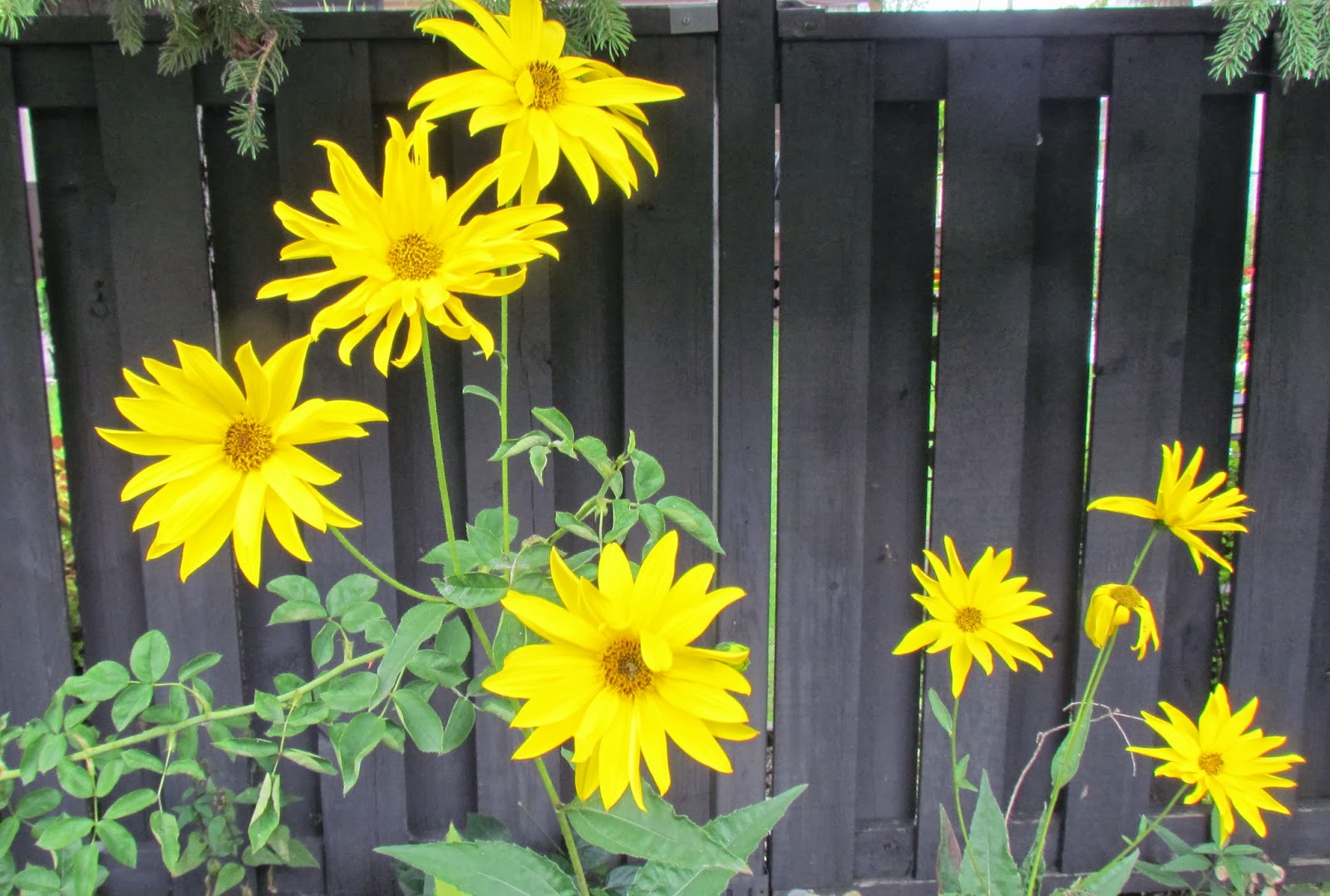
Today's flower was going to be the Jerusalem artichoke.  You can see it on my header at the moment.  This plant is really gorgeous!  I have it growing in my backyard.  That is why I can show it to you today.  You see, my scooter is not working right now, so I can't go out and take photos.  It's a real drag because the weather has been fantastic and so far I have been stuck inside the house.  My battery charger is not working. One has been ordered and it should be here any day, but for now I am a prisoner in my own home.


This plant is in the Asteraceae family.  It has nothing to do with Jerusalem and it is not a type of artichoke. Its botanical name is Helianthus tuberosus.  The tuber of this plant is edible and is said to resemble the taste of an artichoke.  This plant has been cultivated for its root since before Europeans came to this country.


I would write more about it, but I am too excited about my other news!  Even though I have been unable to go anywhere by scooter, my friend, Sylvia has kept me mobile.  Last evening we went to see Kaffe Fassett!

Yes!  The real, live Kaffe Fassett!


Nicole of Log Cabin Yardage in Whitevale had invited him to come to her shop and talk to us.  It was a fantastic lecture!  Even though he didn't bring any quilts with him, his slide show was beautiful.  He outlined his life and interests and how he got started in knitting and quilting.  He is also a painter, which I didn't know, and I loved seeing his paintings.  He is a great speaker, very talented with a terrific sense of humour.  I was totally inspired by this man!

He signed some books I had and I bought a few fat quarters of his fabrics at Nicole's shop.  I just love his fabrics!  The evening was over far too quickly.  Both Sylvia and I could talk of nothing else on our way home.  What a great middle-of-the-week indulgence!

See that 'necklace' around his neck?  Nicole's daughter finger knitted that during his presentation and presented it to him.  What a darling girl!  He graciously let her put it around his neck.  Thanked her and then without skipping a beat, went on answering questions and making us laugh.  I thoroughly enjoyed myself. Thank you Sylvia for doing the driving and thank you Nicole for inviting this talented man and allowing me to come and listen to him speak.


Wednesday, September 25, 2013

Wildflower Wednesday

I will soon have to retire Wildflower Wednesday for this year.  Our days are getting shorter and the nights are getting colder.  But I could not leave you without showing some Asters.  These plants, for me, say, 'Fall'.
There are thousands of species and they are very difficult to tell apart, even for an experienced botanist.  I will not even try to figure out which Asters I have taken photos of.


This is a pretty purple variety.  The flowers are fairly large and it forms dark purple clumps throughout our area, in parks and roadsides.  This plant has inspired several fall-coloured quilts.  I just love it.

Aster means 'star' in Greek.  The flowers truly are like little stars.  This one is a light mauve one.  The flowers are much smaller, but they brighten up many a waste area.


Asters are found the world over, except for Antarctica.  They are mainly grown for their beauty.  I could not find many other uses for this plant.  This white one is very pretty.  It grows upright.  The white is brilliant amongst the yellowing of other plants.


Sorry Folks.  This has to be a short post.  My computer, and especially my photo files, are giving me problems.  

Wednesday, September 18, 2013

Wildflower Wednesday

Today's plant is Dog Strangle Vine, also known as Black Swallow-wort..  It is in the Milkweed family that I talked about last Wednesday, sharing a similar milk-like substance in the stems.  It is very invasive and grows into large tangled colonies.  Because of the common name, some people think that it could strangle a dog if they got tangled up in it, but this is actually not a danger.  This plant is in the Genus Cynanchum.  This sounds like the Greek word for 'dog' and 'to choke' and that is how it got its common name.  It is native to Europe and was brought to North America in the early 1800s.  It has very few natural controls on our side of the Atlantic.

Dog Strangle Vine is very invasive and is a threat to biodiversity, crowding out native plants.   It is reaching epic numbers in our area, growing along highways, waste areas, hillsides, fields, parks as well as gardens.  I even had a few come up in my garden this spring.  This is what it looked like.


When they are small, they can be dug up and destroyed.  But as they grow into large colonies, they are almost impossible to get rid of.


These plants are not only problematic for all plants growing nearby, they also have a negative effect on Monarch butterflies.  Because this plant is in the Milkweed family, it is often confused by the adult Monarch for Milkweed.  When she lays her eggs on the Dog Strangle Vine by mistake, the larva cannot mature since this plant is highly toxic.


In summer the plants flower.  These flowers are very small and some think they are insignificant, but I think they are very pretty.  Above is a shot of the dark purple flowers.  You can see how similar each floret appears to the milkweed flowers in the foreground.


As the seed pods mature, they start to look like very skinny milkweed pods.  The seeds are similar also, floating through the air attached to their parachutes.  I have mixed feelings about this plant.  I have to keep digging up small plants in my garden, which is difficult for me to do.  If we let this plant keep growing out of control it will kill off many native plants and insects, so I can easily hate it.  But I also admire its tenacity, its 'doggedness', so to speak. LOL   It can grow anywhere and everywhere and does very well where ever it plants its roots.  This plant is currently the most hated weed in our area.  As I travel around on my scooter I can see why this is so.  It seems to have taken over large areas of our ravine.  I am fearful for the damage it can do.

Wednesday, September 11, 2013

Wildflower Wednesday

While out riding on my scooter yesterday, I came across a wonderful area full of Goldenrod.  I took a couple of photos even though I had featured Goldenrod last week.  I just couldn't resist. I wish I had had this shot last week, but since I didn't, I will post it now.

This picture does not do this scene justice.  The yellow was  brighter than sunshine, the temperature was summer-like with a high in the low 30s, the grasshoppers were everywhere and the cicadas celebrated the last days of summer with their buzzing songs.  I have this scene implanted in my brain so that I will be able to 'see' it in January when we have a foot of snow.

On the other side of the path were more Goldenrod.  And today's wildflower, the Milkweed plant.


Milkweed gets its name from the thick, white, milky juice inside this plant.  It contains latex and some species are know to be toxic.  It is in the Genus, Asclepias, which is named after the Greek god of healing Asclepius, because this plant has been used to treat many ailments.


I took this photo last spring.  This plant looks great even without flowers or seed pods.


In early summer the flowers open.  It always amazes me how these round flowers can turn into those long seed pods that Milkweeds are famous for.  But they do.  Each flower is pollinated.  The seeds are produced in follicles or seed pods.


Inside the pods the seeds are arranged in overlapping rows.  Each seed has a white, silky 'parachute attached to it.  When the pods ripen and split open the seeds fly through the air attached to their parachutes, much like dandelions.

Perhaps the most important use of Milkweed is by the Monarch Butterflies who depends solely on this plant to feed their larva.  Other insects also use the Milkweed as a food source.

During WWII, the United States collected 5,000 pounds of the white filament fibres to use as a filling instead of kapok.  It is still grown commercially as a pillow filling.

Native South Americans and Africans used the poisons in the sap to tip their arrows, making them more lethal for hunting purposes.

I love the seed pods when they split open and disperse their seeds.  I have collected these pods in the past and used them to decorate Christmas wreaths and other decorations.  They can be spray painted and added to floral arrangements.  I have also used them to make fun things with my students.  I still have a little 'mouse' I made many, many years ago.  It has seen better days, especially after Mimi got a hold of it and decided it was fair game.


Half a pod, some hot glue, a couple of pistachio shells for ears, two black beads for eyes and a piece of string or lace for a tail.  Cute, eh?


Wednesday, September 04, 2013

Wildflower Wednesday

Can't believe it's Wednesday already.  School started yesterday and the weather has turned fall-like.  That means I have to show you an autumn wildflower.  This is Goldenrod.


It's growing in my backyard.  I should have pulled it up in the spring, but I couldn't get into the back of my garden to work there.  So now everything is a gorgeous yellow colour.  Many people consider this plant to be an invasive weed.  I have often thought this too, but it is currently used in gardens, especially wildflower gardens because it is so beautiful.  Goldenrod is in the Asteraceae family.

I have no idea which Goldenrod I have.  It is definitely a plume-like variety - maybe Tall Goldenrod (Solidago altissimo) or Canada Goldenrod (Solidago canadensis).   There are more than 69 varieties growing around here.  This photo shows its plume-like flower heads.


Goldenrod is thought by many to bring good luck or good fortune.  Young leaves can be eaten and a tea can be brewed from the flower heads.  Native Peoples chewed the leaves to relieve sore throats and the roots to relieve toothaches.  Herbal practitioners use Goldenrod to treat kidney and bladder conditions.

This plant attracts insects, including bees and other pollinators.  Several interesting insects sometimes lay their eggs in goldenrods, creating a gall or swollen area on the stem where the larva lives and eats.  Woodpeckers have been known to attack this gall and eat the larva inside.  A type of wasp also digs into the gall and eats the larva.

This is sort of like a wildflower too.  I think the squirrels planted this one in my garden.  So far they have left it alone, but I don't think it will be for long.  That is why I took a photo this morning.  It is so beautiful!


I am going to save some seeds to plant next year.  That is, if the squirrels will let me.

Now getting ready to go out for lunch with my quilt group.  Now that September has started, I am back into the swing of quilty things.


Wednesday, August 07, 2013

Wildflower Wednesday

Meet Joe, Joe Pye Weed, that is.


This plant got its name from a Native American, Joe Pye, who used it to make a variety of medicines.  It was used to treat fevers and symptoms of Typhus as well as kidney stones and urinary tract infections.


Joe Pye Weed is a native perennial herb in the Asteraceae family.  I am not sure which Joe Pye Weed I have here, but I think it is Spotted Joe Pye Weed or Eupatorium maculatum.  It has long tapered leaves that grow in a whorl around the stem.  The stem may be spotted or dark purple.  


This plant is a favourite of butterflies, bees and other insects.  It also attracts hummingbirds.  It grows best in moist soils and loves sunshine.  The blooms last throughout the summer and well into fall. New varieties are being developed, at the present time, for use in the garden. This plant is really stunning when you see it in ditches and other waste areas.


Thursday, July 25, 2013

Wildflower Wednesday on Thursday

I want to show you some Vetches and other plants with clover-like flowers.  There are many and I don't have pictures of all of them.  They are in the pea or bean family, Fabaceae or Leguminosae .  This first one is Crown Vetch, Coronilla varia.  The flowers are bicoloured in shades of white and pink.  This plant is widespread in our area.  It is usually planted on steep hillsides along highways because of it's root system, which grows into a sturdy mat that holds the plant and surrounding soil in place.


The leaves are divided into small, paired leaflets.   


Another vetch-like plant in the pea family is Yellow Sweet Clover, Melilotus officinalis.  It is a tall plant with long, tapering spikes of yellow pea-like flowers.

This plant grows in just about any soil, but it loves alkaline soils the best.  It is mainly grown for agricultural purposes, even though it contains a toxin that can turn into an anticoagulant if it gets moldy.  This can cause internal bleeding or even death in cattle.  It must, therefore, be properly dried and cured.   It is also a good source of nectar for bees.

A closely related plant is the White Sweet Clover, Melilotus alba.


The last clover-like plant I have to show you is the Birdsfoot Trefoil, Lotus corniculatus.  This is an herbaceous perennial.  Its flowers develop into small pea-like pods.  The name comes from these seed pods when they are on the stem.  They have five leaves, with three at the top of the stem and two more at the base.  This is where the word trefoil comes from.


This is an important forage plant, used in pastures, hay and silage.  It is also an important nectar source for insects.


Its lovely yellow flowers brighten up any roadside or pasture.

Wednesday, July 17, 2013

Wildflower Wednesday

Today's flower is Chicory.  You probably know why I picked this one.  Because it's blue, that's why! 


Chicory,(Cichorium intybus) is a member of the daisy family (Asteraceae) and a close relative to dandelions. It is a herbaceous perennial and can be found just about everywhere, in fields, roadsides and ditches.  It can be mowed down and survive because it's primary leaves are produced in a whorl, only a couple of inches off the ground.   The flower stems can be 2 to 3 feet tall.  The flowers open in the morning and close around noon when the temperature rises.  Seeds are spread by wind much like dandelion seeds.


This plant was originally native to Europe, especially Southern European countries.  It is thought that it was brought to North America in hay that was used to feed cows on their journey.  It has now become naturalized here.  This plant is not only a great food for cattle, it is also used as a salad green and a cooked vegetable.  The roots can be boiled and eaten, but, perhaps the most common use for them is in the making of a coffee substitute.  Chicory, historically, has had a wide array of medicinal uses, including everything from a tonic, a diuretic and a laxative.  


Hope you have enjoyed this lovely blue flower.  Now I am going to hide out in my basement for the day. We are in the middle of a heatwave.  The temperature is above 32C and with the humidity it feels more like 40C. And wouldn't you believe it!  My airconditioner is not working!!!! The service guy won't be here until tomorrow morning. 

Why do things always break down when they are needed most?


Wednesday, July 10, 2013

Wildflower Wednesday

I love plants with blue flowers.  Oh, but you knew that already.  Today\s plant is called Vipers Bugloss.  It is blue, but I really don't know very much about it.  So I am learning as I go.


Vipers Bugloss grows in poor, sandy soil.  Its flowers are a beautiful blue colour and it is sometimes called Blueweed.  The botanical name for it is Echium vulgare.  The name 'Vipers Bugloss' comes from the word 'Echium', which is derived from the Greek word, 'Echis' for viper.   Many parts of this plant were thought to resemble a viper and it was historically used as a treatment for viper bites.  The word bugloss is derived from the Greek word for ox-tongue, which refers to the shape and roughness of the leaves.   This roughness can cause an itchy, allergic reaction if touched.


But if you look at the photo above you will see some poison ivy growing right in the centre.  If I had touched the plant and developed a rash I would have thought it was due to the poison ivy and not the bugloss.  Vipers Bugloss is in the Borage family, Boraginaceae.  It is a biennial or short-lived perennial and can produce 500 to 2,000 seeds per plant.  It is just starting to fade in my area, but it was beautiful earlier in the spring.  I don't know why I didn't take a picture sooner.

It is considered an invasive species in many areas, but in some parts of the world it is grown near bee hives since bees can turn the nectar from these pretty blue flowers into a delicious honey.

So, Happy Wednesday everyone!   Go out and enjoy some wildflowers today.


Friday, July 05, 2013

This and That

I had wanted to go out this morning, but it is raining, again!  When is this wet weather going to end?

Thank you to everyone who voted for my miniature paper pieced quilt last weekend.  I got 26 votes, not enough for a win, but I'm happy with that.

I also hope that all my friends to the south of us had a great Fourth of July yesterday.

Sorry, I have been missing in action this week.  Monday was a holiday, but that should not have made much difference.  Every day is a holiday for me.  LOL  Then on Wednesday I had a dentist appointment.  Since it only involved putting a filling back in and the fact that I was totally done by 9:00 am, shouldn't have made any difference either.  I guess the thing that bugged me the most this week was trying to locate my photos on my computer.  You see, I sort of, inadvertently, deleted them.  Doh!  How I did that I have no idea.  But they were all gone.  Then last night I was trying different things and I found them on Picassa.  Have no idea how that happened.  Now I have to figure out how access them.

I will now sort of back track over the past week and show you what's been going on around here.  Here is my design wall on Monday.

I am pretty happy with it and think I will sew it together today.  It now measures about 44 in. by 60.5 in.  I may add one more row to the sides and one more row to the bottom.  I'll see how it goes.

I have also been working on another scrappy quilt.  This is a 16-patch.  I have been making these blocks whenever I have a spare moment.  Not too many of those around here, but I do have about 14 blocks done.  Here are 10 of them sewn together.


Now onto Wildflower Wednesday.
The flower for this week was one of the ones I lost.  Actually I found it, but can't figure out how to get to it.  So I have decided to show you the plant, Yarrow.  This plant grows everywhere.  It likes direct sun and fertile ground, but is also happy is less perfect conditions.

This one is growing in my backyard.  I have no idea how it got there.  Maybe I planted it many years ago.  It has soft feathery leaves and that is the reason why it is still in my garden.  One of my old cats, Tobicat, loved to sleep on this feathery plant when the temperatures sky rocketed in the summer.  In fact, we buried his ashes under this plant.  It has great sentimental value and we will never remove it, but I did trim it back a bit this spring because it was getting out of hand.


Yarrow is a very useful plant.  It has been used for food.  The leaves can be eaten like spinach or cooked  in soups.  Plus it has a huge range of medicinal uses.  It has been used as a diuretic, a blood tonic and to treat nosebleeds and menstrual disorders.  Early Europeans took it into battle to treat wounds.  Native Americans used it to treat toothaches and head colds.  A poultice was applied to burns and a tea was made to reduce fever and aid in restful sleep.  And if you could ask Tobicat, he would tell you it makes a wonderful cool, soft bed to nap on.

The botanical name for Yarrow is, Achillea millefolium.  It is in the Asteraceae family.  I also have some light pink ones in my garden and a yellow one which I bought this year.  It is in the front garden and I couldn't get a photo because it meant walking on the grass and that is still difficult for me to do.


My garden is spectacular this year.  I guess it's all that rain we've been getting!  I love this yellow lily.  The colour is so bright and cheerful.


And my first day lily opened this morning.  It is a peach coloured single blossom one.  I love it!  You can see the lavender in the background.  Also very pretty and aromatic.


That's about all for this week.  Wishing everyone a fantastic weekend!


Wednesday, June 26, 2013

Wildflower Wednesday

Very busy!  Tons of stuff going on around here.  We had visitors from Germany spend a few days with us.  Then yesterday I went out to Ajax Downs for lunch with a couple of friends from the last school I worked at.  It was nice to see them again.  We sat by a window and watched the horse races.  It was also my DH's birthday and the phone never stopped ringing with birthday well-wishers.  Today I have to make two batches of pizza dough in my bread maker for my DD.  She wants to serve pizza as an appetizer at her staff's year-end party tomorrow.  I am also trying to work on a few quilty things, but there just doesn't seem to be much time for that.  I joined Em's Scrap Happy Summer 2013.  As if I need an excuse to sew scraps together!  LOL

But on with the program...  Today's wildflower is the Canada Anemone.  This is fitting because next Monday is July 1st, also known as Canada Day in these parts.


The biological name for this plant is Anemone Canadensis.  It is in the Ranunculaceae, better known as the, buttercup family.  There is also a shorter version of this species called a Wood Anemone, but it is much smaller.  The Canada anemone bears pretty white flowers.  These are not true flowers because this plant lacks petals.  But it does have 5 white, petal-like sepals.  The leaves are whorled on the stem and are deeply cut and stalkless.  The flowers rise above the leaves to about 20 inches.

These plants spread by rhyzomes and seeds.  It is a native plant and was used by aboriginal people as an astringent, an eye wash and a cleanser for wounds and sores.  It blooms from May through July and is always a pretty sight in damp forests.

Now back to the tasks at hand.  The weather has been unsettled and unbearably hot and humid here the past few days.  Today the sun is shining brightly.  Hopefully the worst is over and things will cool down a bit and become more comfortable.


Wednesday, June 19, 2013

Wildflower Wednesday

My post is a little bit late today.  I had to recharge my camera's battery before I could download any pictures.

Today's wildflower is the Ox-eye Daisy.  This common wild daisy grows just about everywhere and I am sure you have all seen it before.   It is also known as a White Daisy or Field Daisy.  The flowers are borne at the top of long stems.  They have white rays with a yellow centre and a scent that is not liked by everyone.


The Ox-eye Daisy is in the aster family.  Its botanical name is Leucanthemum vulgare.  This plant is an alien and was introduced by pioneers.  It reproduces itself by seeds as well as through a vigorous rhizomatus system.  In some areas they have become an invasive species and are sometimes a nuisance to farmers.  Although they are a short-lived perennial, they are difficult to control with herbicides.  Cows don't like the taste of them and will shun pastures with daisies, giving the plants more opportunity to spread.


But I love these little flowers and can't wait for them to bloom.  I think I will go out again tomorrow and pick a small bunch to decorate my kitchen table.

Wednesday, June 12, 2013

Wildflower Wednesday

For the past few weeks I have noticed some beautiful plants growing along the highway and in waste areas.


I had always thought that they were a wild phlox, but after taking some photos and looking at the flowers more closely, I realize that these plants are called 'Dames Rocket'.  You see, Phlox flowers have five petals and Dames Rocket only has four.


They come in many colours, from white to pink to lavender and purple.  The interesting thing is that they are in the Mustard Family.  Seeds are produced in a similar manner as other mustard plants.  The botanical name for them is Hesperis Matronalis.  Hesperis means a tall herb with fragrant flowers. and Matronalis means belonging to a married woman.

Dames Rocket was brought to North America by early settlers from Europe.  In some areas it is considered an invasive species, only slightly less noxious than Garlic Mustard which I showed you a couple of weeks ago.    But I just love the looks of this plant in wild areas.  It blooms in spring when there is not much else in bloom.  It is colourful and smells terrific.  And it is thought to be useful in the treatment of some forms of cancer.  What more could you ask for?